1. Why High Southern Canopies Reduce Rooftop PV Output by Up to 40%
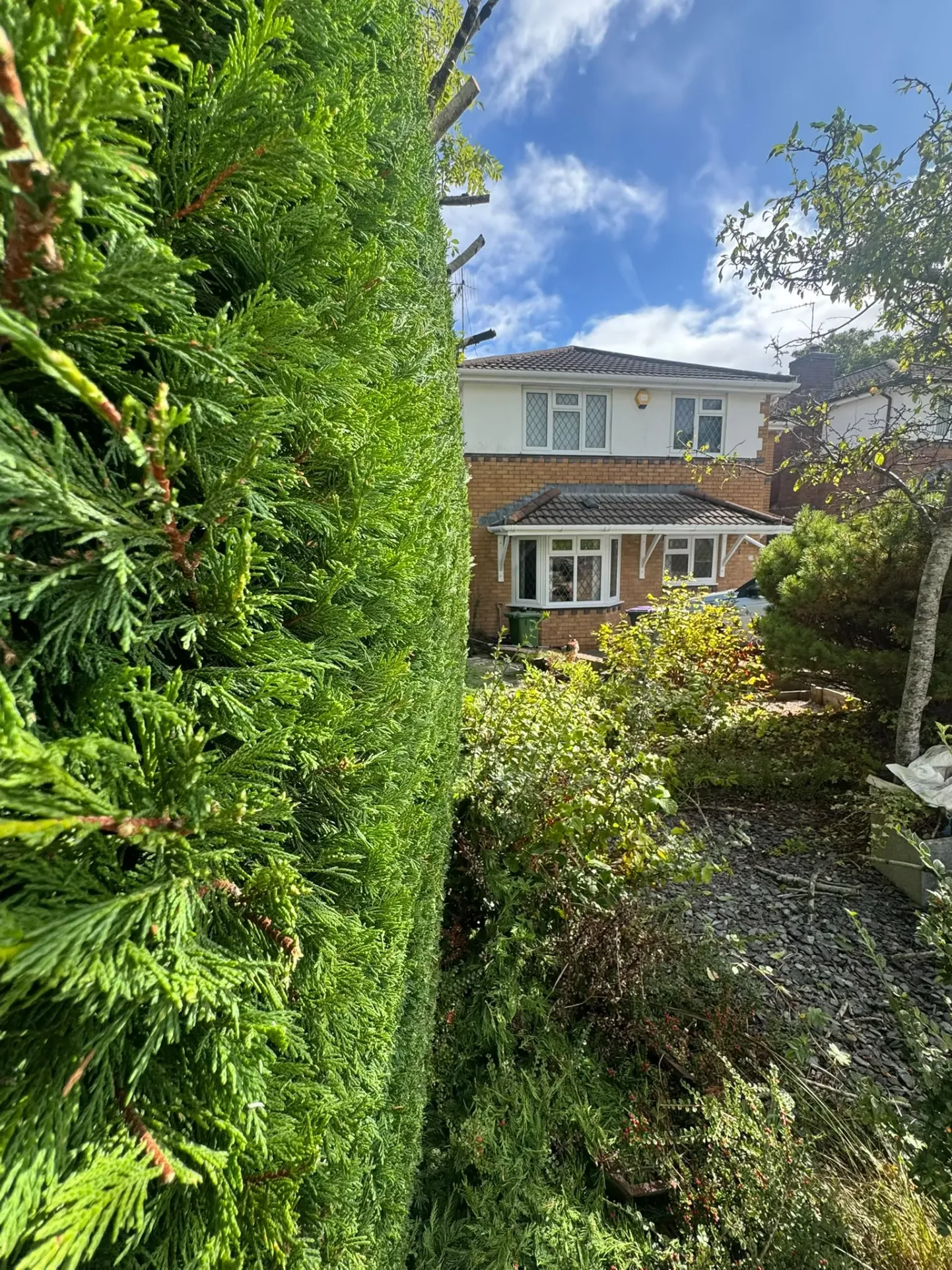
Homeowners across South East Wales—from steep hillside terraces in Pontypool and Blaenavon to mature detached properties in Abergavenny, Chepstow, and Newport (Gwent)—have invested heavily in rooftop solar photovoltaic (PV) arrays and high-speed satellite dishes. However, a tree that cast zero shadow onto your roof when your panels were installed in June can severely cripple your system from October through to March, or as its upper leader shoots add 1.5 to 2 metres of vertical growth over a few damp Welsh summers.
Solar panels do not respond linearly to shade. Because standard photovoltaic cells within a solar module are wired in series (and panels themselves are often wired in series strings to a central inverter), shading just 10% of a single solar panel can reduce the electrical output of the entire string by 30% to 40%.
The "Christmas Tree Light" Effect & Bypass Diode Activation
When a narrow band of shadow from an ash, oak, sycamore, or conifer canopy falls across a solar panel, the shaded cells cease generating current and instead act as electrical resistors. To prevent the shaded cells from overheating (known as hot-spotting), the panel's internal bypass diodes trigger, shutting down that entire third or half of the panel.
- Summer Foliage Shading (April – September): Dense leaf cover blocks direct beam irradiance completely, forcing the inverter's Maximum Power Point Tracker (MPPT) down to a lower voltage plateau and cutting peak daytime generation by up to 40%.
- Winter Bare-Twig Shading (October – March): Even after deciduous trees drop their leaves in autumn, the criss-crossing lattice of upper branches casts hard-edged shadows across the low winter sun path. This triggers rapid bypass diode switching and prevents string inverters from reaching their start-up voltage threshold on bright, crisp winter mornings.
- Valley Microclimate Debris & Lichen: Overhanging or high adjacent canopies increase localized humidity and shed sticky aphid honeydew, pollen, and leaf litter onto glass panels, accelerating black algae and lichen colonisation that permanently degrades light transmission.
2. Calculating Sun Angles & Canopy Clearance in Pontypool (51.7°N)
To specify an accurate crown reduction rather than guessing how much height to remove, a professional tree surgeon calculates the solar elevation angle for our specific latitude in South East Wales (approximately 51.7° North for Pontypool, Torfaen, and Monmouthshire, and 51.58° North for Newport and Caldicot).
The sun's maximum midday altitude changes by 47 degrees between the summer solstice in June and the winter solstice in December:
| Season / Date | Midday Solar Altitude (51.7°N) | Shadow Length Multiplier | Max Tree Height Above Roof Eaves (at 15m Distance) |
|---|---|---|---|
| Summer Solstice (21 June) | 61.7° above horizon | 0.54 × tree height | +27.8 metres above roof |
| Spring / Autumn Equinox (Mar / Sep) | 38.3° above horizon | 1.27 × tree height | +11.8 metres above roof |
| Mid-Autumn / Late Winter (Nov / Feb) | 23.0° above horizon | 2.35 × tree height | +6.3 metres above roof |
| Winter Solstice (21 December) | 14.8° above horizon | 3.78 × tree height | +3.9 metres above roof |
How to Calculate Your Required Tree Crown Reduction
You can estimate how much upper canopy needs to be lowered using basic trigonometry:
Practical Pontypool Example: Suppose your two-storey property has solar panels mounted at 6.0 metres above ground level, and a mature ash or sycamore tree stands 12.0 metres due south of your roof ridge, currently standing at 14.5 metres tall.
- For Mid-Winter Clearance (15° sun angle): 6.0m + (12.0m × 0.268) = 9.2 metres maximum height. At 14.5 metres, the top 5.3 metres of the tree casts a solid shadow across your panels all day in December and January.
- For 10-Month Optimal Clearance (23° sun angle, Feb–Nov): 6.0m + (12.0m × 0.424) = 11.1 metres maximum height. Performing a targeted 3.0 to 3.5-metre upper crown reduction clears the entire solar window from early February right through to November while preserving a healthy, natural tree structure.
Torfaen Valley Slope Adjustment: On hillside terraces in Pontypool, Griffithstown, Abersychan, and Blaenavon borders, a tree growing on the upslope (southern side) of a terraced garden starts with a 2-to-4-metre ground elevation advantage. This drastically reduces the effective solar horizon and often requires combining crown reduction with selective crown thinning or sectional tree felling if the specimen has outgrown a narrow terrace plot.
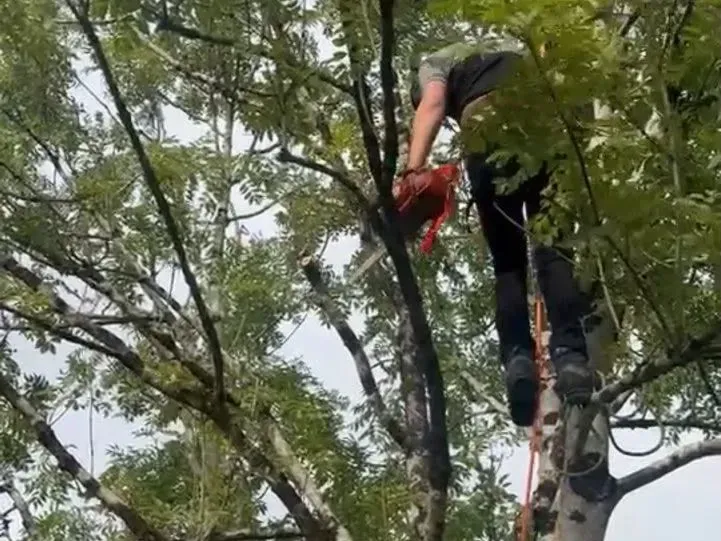
3. Satellite Dish & Rural Broadband Line-of-Sight Clearance (Sky, Freesat & Starlink)
While solar panels suffer gradual percentage losses from canopy shading, satellite television and rural satellite broadband rely on high-frequency Ku-band and Ka-band microwave signals (10.7 GHz to 30 GHz). At these short wavelengths, wet leaves and sap-filled twigs act as solid radio-frequency barriers.
This phenomenon—known to engineers as foliage attenuation and rain fade—explains why your satellite signal may work perfectly in January, begin pixelating in May as beech or sycamore leaves unfurl, and drop out completely during a heavy South Wales rainstorm in July.
Geostationary Dishes (Sky Q / Freesat)
UK television dishes point at the Astra 28.2°E satellite cluster positioned over the equator. From Pontypool, Newport, and Chepstow, the signal beam requires a narrow, unobstructed "keyhole" corridor:
- Compass Bearing (Azimuth): 143° to 145° South-East.
- Elevation Angle: 23.2° above the horizontal horizon.
- Clearance Rule: For every 10 metres away a tree stands along that 144° SE line, the canopy top must remain at least 4.3 metres above dish level or lower. Often, creating a targeted "crown window" or reducing a single south-eastern limb restores 100% signal lock.
Low-Earth Orbit (Starlink Rural Broadband)
Many rural properties around Abergavenny, Usk, Shirenewton, and the Monmouthshire hills rely on Starlink. Unlike Sky dishes, Starlink tracks moving satellites across a wide 100° to 110° field-of-view cone tilted slightly North-by-North-East or straight overhead:
- Minimum Horizon Angle: 25° above horizon in all directions (especially North, East, and West).
- Impact of Tall Canopies: High perimeter conifers or overhanging ash trees clip the outer edges of the phased-array cone, causing micro-dropouts during video calls.
- Arboricultural Fix: Symmetrical crown reduction or tall conifer hedge reduction drops the surrounding horizon below the 25° obstruction threshold.
4. Why Proper Crown Reduction Beats "Tree Topping" for Solar Clearance
A common mistake homeowners make when trying to clear a solar array or satellite sightline is hiring an unaccredited operator to "lop" or "top" the tree straight across at an arbitrary height. In professional tree surgery, indiscriminate topping is destructive and counter-productive—especially for solar panel owners.
When a broadleaf tree (such as sycamore, willow, lime, or oak) is crudely topped across its main stems, the tree goes into biological shock and triggers an emergency survival response called epicormic sprouting (water shoots). Within 12 to 18 months, each cut stump sends up between 6 and 10 vigorous vertical shoots growing up to 2 metres per year, bearing oversized leaves that cast an even denser wall of shade than the original canopy.
Our BS 3998 Drop-Crotch Reduction Process
At JDP Outdoor Solutions, all tree pruning and crown reductions are executed in accordance with British Standard BS 3998:2010 (Tree Work – Recommendations):
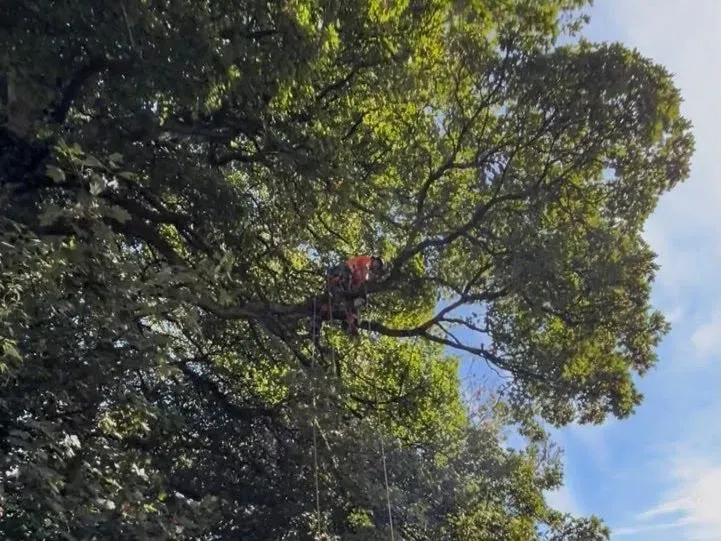
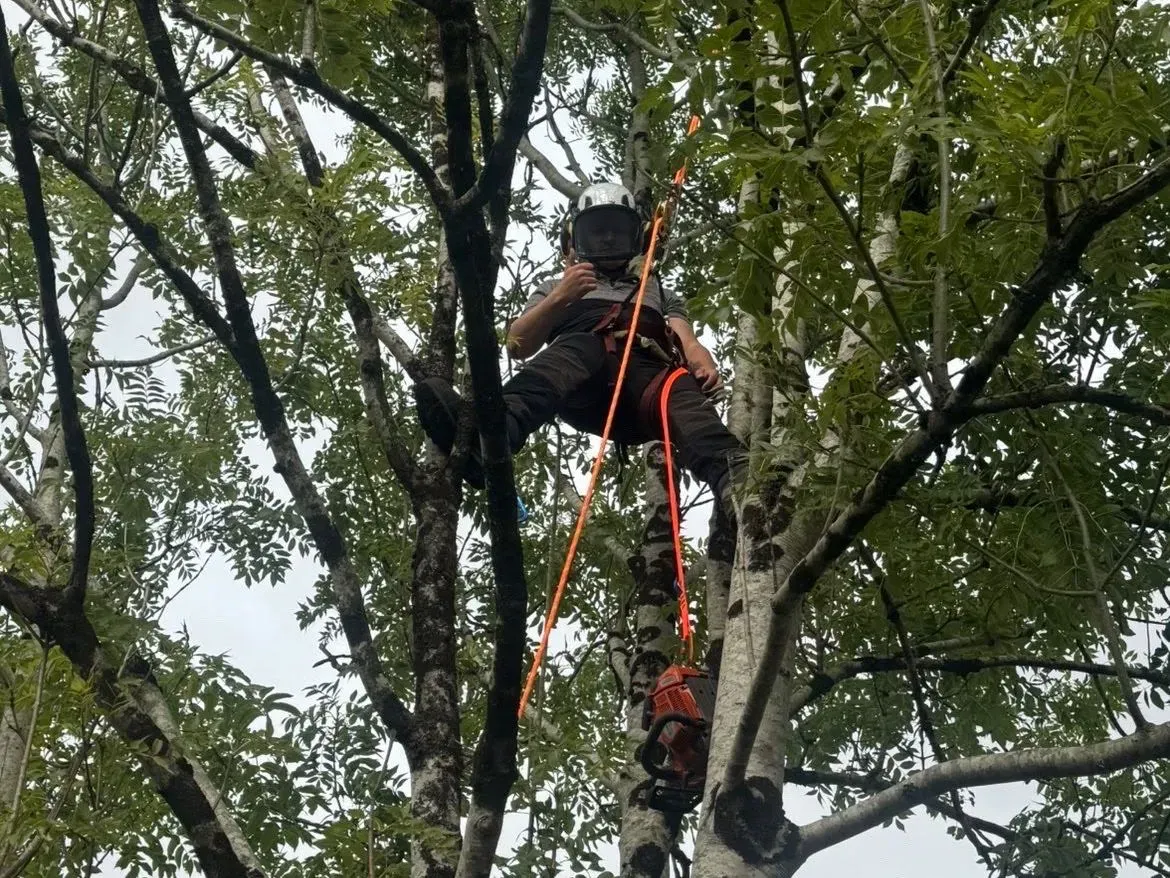
- Sightline & Solar Arc Assessment: Before climbing, Jac Price assesses the tree from your garden and roofline perspective, identifying which specific upper leaders and south-west/south-east lateral branches cross the winter solar arc or satellite azimuth.
- Reduction to Viable Lateral Growth Points: Rather than leaving bare stubs, we prune each outer leader back to a healthy side branch (lateral) that is at least one-third the diameter of the stem being removed. This maintains apical dominance (hormonal control), suppressing rapid water-shoot regrowth so your solar clearance lasts for years rather than months.
- Targeted Crown Thinning (15%–20%): Where a mature tree cannot be lowered by the full winter solstice height without harming its structural integrity, we combine a 2-to-3-metre height reduction with selective internal crown thinning. Removing crossing and congested inner branchlets significantly increases winter light filtration and cuts wind-sail resistance on exposed Torfaen valley slopes.
- Rigging & Property Protection: Working near solar glass, satellite LNBs, greenhouses, and boundary fences requires zero-drop precision. Using friction bollards, lowering ropes, and sectional dismantling techniques, every cut limb is controlled down to ground level safely.
5. Planning Rules, TPOs, Neighbouring Trees & Nesting Laws in Gwent
Before lowering a tree or tall hedge to improve solar yield or satellite reception across Pontypool, Newport, or Monmouthshire, three legal frameworks must be checked:
A. Tree Preservation Orders (TPOs) & Conservation Areas
Strict tree protection controls apply in historic areas such as Pontypool Park environs, Abergavenny, Usk, Chepstow, and parts of Caerleon/Newport. If a tree is covered by a TPO or stands within a Conservation Area (with a stem diameter over 75mm at 1.5m height), you must submit a formal application or 6-week Section 211 notice to Torfaen County Borough Council, Monmouthshire County Council, Newport City Council, or the Bannau Brycheiniog National Park Authority. Local planning authorities rarely approve complete tree felling solely for solar shading, but they routinely grant consent for sympathetic BS 3998 crown reductions of 15%–25% that balance renewable energy generation with visual amenity.
B. When a Neighbour's Tree Shades Your Solar Panels ("Right to Light" & High Hedges)
Under UK common law, you have the right to prune overhanging branches back to your vertical boundary line (subject to TPO checks), but you cannot cross into a neighbour's garden to reduce the height of their tree without their explicit permission. However, if your solar panels are shaded by a neighbour's line of two or more evergreen or semi-evergreen trees/conifers (such as Leylandii or Laurel) exceeding 2 metres in height, you may have recourse under Part 8 of the Anti-social Behaviour Act 2003 (High Hedges legislation). In our experience, approaching neighbours constructively and offering to fund a professional crown reduction or hedge height reduction that also improves light into their own garden resolves 95% of disputes amicably.
C. Wildlife and Countryside Act 1981 (Nesting Season Timing)
It is a criminal offence to disturb active bird nests or destroy bat roosts. The main bird nesting season runs from March to August. Consequently, the ideal window to book upper-crown reductions for solar and satellite clearance is late autumn through late winter (October to February)—which also coincides with the exact time of year when low winter sun angles make shading angles easiest to verify on site.
6. Typical Costs & Solar Payback in South East Wales
For a typical 4kWp to 6kWp domestic solar PV system in South Wales generating roughly 3,800 to 5,200 kWh per year, losing 35% of your generation to southern canopy shade costs a household between £350 and £550 every year in lost self-consumption and Smart Export Guarantee (SEG) payments.
Every tree and garden access point in the Welsh valleys is unique—ranging from level suburban driveways in Caldicot and Newport to steeply tiered hillside gardens in Pontypool requiring rope-and-harness climbing and manual brash extraction. When we visit your property for a free, no-obligation quotation, we price transparently based on:
- Tree Height & Canopy Spread: Small-to-medium ornamental or fruit trees vs mature 18-metre oaks, ashes, or conifers.
- DropZone Obstacles: Whether branches can be free-felled into a clear lawn or require technical sectional rigging over greenhouses, conservatories, or boundary fencing.
- Licensed Green Waste Disposal: JDP Outdoor Solutions holds a Full Upper Tier Waste Carrier Licence regulated by Natural Resources Wales (NRW). Every load of chipped brash and timber is legally removed and recycled through authorised South Wales transfer stations—protecting you from Duty of Care fly-tipping fines.
- Alternative Complete Removal: If a self-seeded sycamore, diseased ash (suffering from Ash Dieback), or outgrown conifer is too close to your southern roof elevation for a reduction to be viable long-term, we can quote for complete tree felling and below-ground stump grinding.
Need Your Trees Lowered to Restore Solar Output or Satellite Signal?
Call Jac and the team for a free, honest on-site assessment across Pontypool, Torfaen, Newport, Chepstow, Caldicot, and Abergavenny. We will inspect your sightlines, advise on TPO rules, and give you a clear fixed quote.
Frequently Asked Questions: Solar & Satellite Tree Clearance
Do I need council permission to reduce a tree shading my solar panels in Torfaen or Monmouthshire?
If the tree is protected by a Tree Preservation Order (TPO) or sits within a designated Conservation Area (such as pockets of Abergavenny, Chepstow, or Pontypool Park environs), an application must be submitted to the relevant council (Torfaen, Monmouthshire, or Newport) before work begins—unless the tree is dead, dying, or poses an immediate hazard. For unprotected domestic garden trees, no council permission is required.
How often will a tree need crown reduction to keep my solar panels unshaded?
When pruned properly using BS 3998 drop-crotch reduction techniques rather than crude topping, most mature broadleaf trees (such as oak, beech, birch, and field maple) only require maintenance reduction every 3 to 5 years. Fast-growing species like willow, poplar, or Leylandii conifers may benefit from a lighter maintenance trim every 2 to 3 years.
Can you cut a "window" through a tree canopy for a Sky dish instead of felling the whole tree?
Yes. Because geostationary satellites at 28.2° East use a tight directional beam at a 23.2° elevation angle, we can often perform selective internal branch removal ("crown windowing") or a directional crown reduction on the south-eastern quadrant of the canopy. This restores 100% satellite signal lock while preserving the visual privacy and screening of the tree.
Are you licensed to take away all the branches and green waste after the reduction?
Yes, JDP Outdoor Solutions holds an official Upper Tier / Full Waste Carrier Licence. We chip all brash and remove all timber and foliage from your property, guaranteeing that your green waste is disposed of legally at authorised South Wales recycling facilities.